Showing posts with label Kamehameha the Great. Show all posts

Thursday, June 11, 2009

Happy Kamehameha Day!

Today, June 11, is Kamehameha Day, a public holiday in Hawaii. The day was first established as a holiday in 1871 by royal decree of Kamehameha V. Since the following year, 1872, it's been celebrated on the islands with floral parades.

Today in Honolulu, long leis were draped around the arms and neck of the statue of Kamehameha the Great that stands across the street from 'Iolani Palace. The parade went from the palace to Kapi'olani Park.

When I was in Maui recently, the ladies at the Ka'anapali Beach Hotel were busy talking about preparations for the parade in Lahaina. They were trying to find enough lokelani, a type of rose, to make a lei for the parade princess. The other women, who, like the princess, would be on horseback in the pä'ü parade (so-called for the 19th-century ladies' riding garb that is customary), would be wearing leis, as well. But because lokelani, the traditional lei flower for Maui, was in short supply, their leis were to be made from another, similar flower.

To illustrate this post, I've chosen a photo from my trip to 'Iao Valley at Wailuku. I visited there en route to the airport to fly home to Portland from Maui. It's the site of the great battle in 1790 between Kamehameha the Great and the Maui chief, Kalaniküpule.

Kamehameha had the advantage, thanks to modern firepower in the form of cannon from ships that had stopped (or sunk) at the Big Island of Hawaii. Kamehameha had two former English sailors in his employ and they operated the cannons. The resulting rout in the 'Iao Valley was known as the Battle of Kepaniwai, the damming of the waters. It was all the bodies of the fallen Maui warriors that clogged the streams.

The smaller rock in the photo, a landmark of the 'Iao Valley, is what is called the 'Iao Needle. It was thought to be the phallus of Kanaloa, the god of the ocean.
Posted by Picasa

Sunday, February 8, 2009

The Hämäkua Coast

My Fun Fact at last Thursday's hula class took the form of a geography lesson. A dance we learned recently accompanies the mele ma'i entitled "Ka Ua I Hämäkua," or The Rain at Hämäkua." The first line is about the rain at Hämäkua and the sea at Opae'ula. So I was curious myself and figured my hula sisters as well would like to know where these places are.

What we did know was that the place names figured in the life of Kamehameha the Great. I figured they would be in the same vicinity, but as it turns out, Hämäkua and Opae'ula are hundreds of miles apart on the Big Island of Hawai'i.

Hämäkua is the name given to the north coastline that runs west from Hilo to North Kohala, which is thought to be the king's birthplace. The coast is characterized by lush vegetation, thanks to the rain mentioned in the song's title. The rainfall along the Hämäkua Coast, in fact, averages 84 inches, but in some places is as high as 140 inches a year. There are pali, or high cliffs and many waterfalls. Akaka Falls, which is 400 feet high, is the best known of these.

As I told in an earlier Fun Fact, one of the several parallels between the life of Kamehameha and the life of Jesus was that the ruler in Hawai'i at the time of Kamehameha's birth somehow knew of the baby's great destiny and ordered baby boys in the region to be slaughtered. Kamehameha was taken into hiding into the Waipio Valley along the coastline.

The ancient forests were once cleared to grow sugar cane, but the last sugar cane plantation shut down in 1994. Now the land is cultivated by small farmers growing traditional crops, such as taro.

The other place name, Opae'ula, is on the west coast of Hawai'i, just south of Kona. Kona was the seat of Kamehameha's power once he became a king. Opae'ula is actually a 12-acre pond that was an ancient fish pond. The word opae'ula means red shrimp. There are still plenty of the little buggers living in the water there. Now Opae'ula is a bird sanctuary. The birds find the little shrimp quite tasty. I found several YouTube videos showing the shrimp swimming in tanks. There's even a web site about them that's called petshrimp.com. Who knows? Maybe Hawaiian red shrimp are catching on and someday will be a greater sensation than sea monkeys.

Friday, January 9, 2009

Lonely Guy the Great

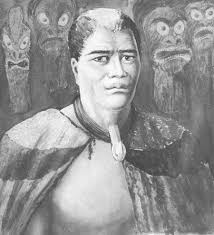
The Fun Fact I delivered to my hula class last night was about Kamehameha the Great, who united the Hawaiian Islands in the late 18th century and early 19th century. He was the first in a line of monarchs who reigned over the islands until 1893, when Queen Lili'uokalani was overthrown.

There was a lot about this king's story that really amazed me. First of all, his name. He had a reputation as a fierce warrior who spilled rivers of blood in his quest to rule the entire island group. So you would think his name would denote all sorts of righteous qualities, such as bravery, leadership or even skill on a surfboard (the sport of kings -- Hawaiian kings, that is).

No. Kamehameha translates as Lonely Guy. So this fearsome monarch was Lonely Guy the Great!

Of course, as soon as I shared that Fun Fact, one of my hula sisters broke into song: "Hey there Lonely Guy," sung to the tune of that 1970 hit, "Hey There Lonely Girl."

There were more amazing things to come. Turns out, Kamehameha's life story shares events that also occurred in the lives of Jesus, King Arthur and Mark Twain!

According to legend, a comet was supposed to light up the night sky when the future unifier of the islands was born. Sure enough, when little Lonely Guy was born in 1758, Halley's Comet soared over the island of Hawai'i. (Mark Twain was born under similar circumstances 77 years later when Halley's Comet returned.)

I'm guessing his was the only birth among the ali'i (royalty) that night, so the people figured he was the long-awaited unifier. The king who ruled Hawai'i Island at the time wasn't exactly charmed by this story of the little baby who would grow up to be a great ruler, so he ordered that the baby be killed. Sound familiar yet? Baby Kamehameha was taken into hiding for about the first five years of his life.

Here's where the King Arthur part comes in. As you may recall, King Arthur proved his exalted destiny by pulling the sword Excalibur from a stone. Kamehameha banished any doubt about his destiny by hoisting the 5,000-pound Naha stone. The immense chunk of lava had sat undisturbed for eons. Only the person who would one day unite the island would ever be able to move it. Kamehameha was said to have performed this amazing feat when he was only 14.

By 1795 he had gained control over all the islands but Kaua'i and Ni'ihau. This he had accomplished through bloody warfare. But by 1810 he had apparently mellowed enough to try his hand at diplomacy. The last two islands decided then not to fight him but to join him.

Having accomplished his destiny, Kamehameha retired from the royal court in Honolulu to his home island of Hawai'i in 1812. He died in 1819 and was succeeded by his son, Liholiho, who took his father's name, becoming Kamehameha II, or Lonely Guy No. 2.