Showing posts with label Kaua'i. Show all posts

Saturday, March 28, 2009

Hi'iaka

We've been learning a new dance in hula class, a kahiko (ancient) hula called Makani O Kona (Kona Wind). One of the lines of the mele is, "'Ike ia a Hi'iaka au i ke kai." (We see Hi'iaka who travels the seas.)

Hi'iaka, it turns out, is the little sister of Pele, the volcano goddess who resides in the crater of Kilauea, the currently active volcano on Hawai'i island.

Legend has it that Pele left Tahiti with the other Polynesians who were seeking a new home and eventually settled on the Hawaiian Islands. She carried with her an egg bearing her little sis. Once they were safe in their new home, Hi'iaka was hatched.

Although another one of Pele's sisters, Laka, is considered the goddess of hula, all three sisters were patronesses of the hula and Hi'iaka loved to dance with her best friend, Hopoe, in a grove of 'ohia trees near the beaches of Puna on Hawai'i Island.

The flower of the 'ohia tree is the 'ohia lehua, the red flower pictured in the illustration above growing on the trees and worn on Pele's head.

One day Pele's spirit left her body and traveled to Kaua'i, where she met and fell in love with the handsome young chief, Lohi'au. After making love with him for days (phew!), she had to leave him and return to her body, back on Hawai'i. But she asked her little sister to go fetch Lohi'au and bring him back to her so they could pick up where they left off, this time with Pele fully in her body. But poor Lohi'au missed out on that treat. When Hi'iaka arrived on Kaua'i she learned that Lohi'au had died of grief shortly after Pele left him. But with time and great effort, Hi'iaka managed to bring him back to life.

Meanwhile, temperamental Pele assumed that because Hi'iaka was taking so darn long, her sister had betrayed her and was doing the old 'I'm the better sister' thang, by demonstrating her charms with Pele's man. Unfortunately, Pele was the type to get mad and ask questions later. So she flew into a rage and caused hot lava to flow over Hi'iaka's beloved 'ohia grove. Oops! Seems she zapped her sister's best friend, too. Poor Hopoe had been hanging out in the grove, waiting her her hula pal to return.

I love the fact that the Hawaiians imbue their gods and goddesses with mortal traits and flaws. In fact, with three sisters of my own, I identify strongly with the story of Pele and her sisters.

I, of course, am the good one.

Wednesday, March 25, 2009

Racism in Paradise

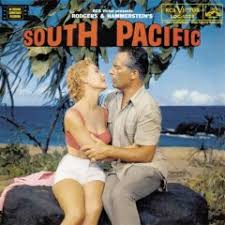
I remember my big sister walking through the house when she was a teenager, singing, "I'm gonna wash that man right out of my hair." She had some other favorite tunes from what was a blockbuster movie in 1958, "South Pacific," and she probably sang those around the house too, because I recognized most of the songs when I at long last watched the movie myself, compliments of Netflix.

To my sister, it was just a romantic story: Navy nurse meets suave and handsome French plantation owner on a beautiful Polynesian island. They overcome problems presented by the war in the Pacific and their minor cultural differences and by the movie's end they happily face their future as a married couple.

I became interested in watching it when I learned it was filmed on the north shore of the island of Kaua'i. I was curious to see if I would recognize any landmarks after my brief visit there a year ago. But when I watched South Pacific the other night I was surprised to learn that the underlying theme of this romantic musical is racism.

I read that the story, first presented in a Broadway musical and later in a film, was considered quite daring in its day. After all, there are scenes in which a W.A.S.P. Marine lieutenant passionately kisses a Polynesian woman. Whoa!

And one of the barriers the cute nurse and the plantation owner face is her horror over the fact that he was once married to a Polynesian woman and fathered two dusky little children. In fact, as soon as she learns this fact, she breaks off the romance and tries to get a transfer off the island so she'll never have to see him again. But before she learned that he'd once been married to a "colored" woman, she had been professing her love and dreaming of their life together.

The Marine lieutenant was in a similar pickle. He was hopelessly in love with beautiful Liat, inspiration for the timeless Rodgers & Hammerstein song, "Younger than springtime." When Liat suggested they take their relationship to the next level and marry, Lt. Crane flatly stated, "I can't marry you." It was because she was of another race.

The song, "Carefully Taught," is Lt. Crane's explanation of his own upbringing, how the beliefs about propriety were pounded into his head from childhood. You sense that he's on the verge of rebelling against the rules of society that dictate he will marry the nice girl from Philadelphia and join the family firm. But, alas [spoiler alert!], he is felled by a Japanese machine gun.

Perhaps the idea of a movie marriage between two races was not palatable. Instead, the silly nurse decides that the Frenchman, after proving himself a selfless hero in the war against the Japanese, is worthy of her love, in spite of his (ahem!) past.

I'm glad that before I watched this film I followed the recommendation of a friend and watched a PBS documentary on The Massie Affair. It was the rather disquieting story of an unstable and immature Navy wife in Honolulu who, after a quarrel with her husband, stormed off and later reported that a group of young Hawaiian men had gang raped her. The 1931 incident became a cause celebre, attracting the famous lawyer Clarence Darrow to Honolulu to defend Thalia Massie's husband and mother, who took it upon themselves to defend the nutty woman's honor by kidnapping and killing one of the innocent "suspects."

From the documentary I learned that the admiral in charge of the naval force stationed in Hawaii in the 30s was an incorrigible racist from the American South, who freely used the "N-word" to describe Hawaiians. In fact, American officers had easily adopted the South's racist attitudes in relation to the native people. The Hawaiians, who had already endured years of subjugation and degradation at the hands of the American Christian missionaries, were basically denied any sort of civil rights by the U.S. military.

I must say, after learning about the Massie Affair and after watching South Pacific, I have a greater sympathy and understanding for the undercurrent of resentment against haoles in Hawaii.