Saturday, October 24, 2009

Ho'oponopono

My Fun Fact for this week's hula class was about an ancient Hawaiian ritual that has in recent years been adopted by the New Agers. It's ho'oponopono, which means "setting things right." The root of the word is pono, which means right, proper or correct.

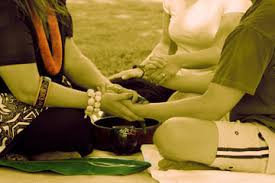
I don't blame the New Agers for claiming this principle. Basically, its purpose is to prevent resentments, grudges, feuds or even unhealthy, negative thinking to fester or continue. The ritual was performed with whole families participating. It resembles an alcohol or drug intervention, or a court mediation, except that the focus is not on just one person. Everyone in ho'oponopono takes responsibility for whatever they contributed to the situation.

Typically, an elder of the family would lead the process. Or a kahuna, or ho'oponopono practitioner, would be called in. It would begin with a prayer. In pre-Christian days, the aumakua, or family gods, would be called on for assistance. And during the process there would be frequent pauses for silence, or ho'omalu, when participants could gather their thoughts and emotions, before proceeding with the discussion, just to keep everything on an even keel.

Everyone in the family conference would be required to admit their wrongdoing in contributing to the problem, and to ask for forgiveness. Everyone else would offer their forgiveness as each person would "come clean." The elder or kahuna might decide upon some action or chore that would constitute restitution. And then the problem, whatever it was, would be wiped away. No more angst. No more seething resentments. That sounds lovely!

One of my hula sisters told me that she had recently read on a New York Times blog about how ho'oponopono is being used in child abuse cases. A practitioner is sent to the child's home with the task of getting every member of the family to admit to, repent and do restitution for the harm they've done to the child. Talk about a knight in shining armor! There were times in my childhood I would have welcomed a ho'oponopono practitioner with open arms.
There are various self-help organizations that use a form of ho'oponopono. A recent book, Zero Limits, by Joe Vitale, offers a form of the practice. One group suggests frequent intonation of a mantra: "I love you. I'm sorry. Please forgive me. Thank you."

But my understanding of ho'oponopono is that dealing with a problem requires something deeper, more thoughtful and more active than reciting a mantra. In fact, ho'oponopono is meant to peel away the layers of an existing problem, get to its very root and then wipe it clean to make a family or group healthy and whole again. It takes full participation and responsibility by all who partake.

Friday, October 16, 2009

Bruddah Iz

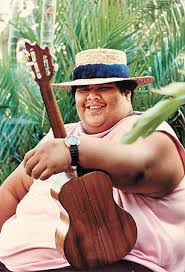
Last night at hula class my Fun Fact was about Israel Kamakawiwo'ole, more commonly known as Iz or Bruddah Iz.

We are learning a new hula, to the tune of "Papalina Lahilahi" (Dainty Cheeks), as sung by the Makaha Sons of Ni'ihau. When I listened to the music I thought I recognized a certain angelic voice. Sure enough, it was Iz. He and his brother belonged to the Makaha Sons of Ni'ihau before Iz went solo in 1990. Of course, he is now best known for his rendition of "Somewhere Over The Rainbow/Wonderful World," which he recorded in one take one night in 1993. It catapulted him from local to international fame.

He was born on O'ahu in 1959. His family name, Kamakawiwo'ole, literally means fearless face or fearless eyes. He was named Israel for reasons I don't know. At first I thought perhaps his parents had given all their children biblical names. Then I learned that Iz's big brother was named Skippy.

There is no Book of Skippy in the Old Testament.

When Iz was about 10 the family moved to the town of Makaha, on the leeward side of O'ahu. Iz was sitting on the beach one day playing his 'uke when he met a few of the guys who would one day become members of the group he and Skippy formed when Iz was 17. The group was together for 15 years and during that time recorded 10 albums.

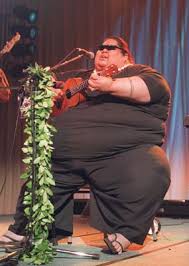
Iz and Skippy's mom was from Ni'ihau; hence the name of the group. Both brothers struggled with obesity. Iz kept vowing to drop a few hundred pounds or so, but he kept getting bigger and bigger. At his maximum weight, he tipped the scales at 757 pounds. He was 6'2". Complications of obesity claimed Skippy in 1982 when he died of a heart attack at age 28.

Iz lasted 10 years longer than that, dying at age 38 in 1997. Toward the end, he had to be raised on stage by a forklift and breathe oxygen from a tank. He left a wife and 14-year-old daughter. His body lay in state in a koa wood coffin in the State Capitol. He was cremated and his ashes were scattered in the Pacific Ocean.

In his earlier years he had been addicted to drugs, but he managed to beat that. In fact, for a while he toured schools to deliver a "Say No to Drugs" message. My 'ukulele teacher remembers seeing him when he visited Hilo High School, where she was a teacher. That was before he was famous and she didn't know anything about him. She said she took one look at him and said, "Ho! Dat guy really big, yeah!" She said he said to the students: "Hey, kids. You no do drugs, 'kay?" And then he began singing and playing his 'ukulele.

On YouTube videos of him I am always amazed to see him cradling that tiny instrument against his leviathan body and then making heavenly music, accompanied by his angelic voice.

Wednesday, October 14, 2009

The Kumulipo

The Fun Fact I shared with my hula class last week was about the Kumulipo, the creation chant that has existed since about 1700 to explain the origin of species, the creation of the Hawaiian Islands and the Hawaiians themselves. Literally, it means the source of deep darkness.

Before the New England missionaries came in 1820 and made Hawaiian a written language, the Kumulipo was passed orally from generation to generation by chanters who were trained to memorize the 2,102-line account and to chant it properly. The presentation of the chant was reserved for very auspicious occasions, such as the birth of ali'i, or royalty.

The Kumulipo took three hours to recite. I learned that one of the auspicious occasions when it was recited was at the ceremony to greet Captain Cook, who the Hawaiians believed was a god.

This gives me a valuable insight into the disaster that followed. The survivors of the incident, British sailors who had served under Cook's command, reported that Cook, who had ordinarily taken great pains to be respectful of native cultures, turned quite crabby and irritable while in Hawaii. In fact, it was his temper tantrum over some stolen nails that really irritated the Hawaiians and caused them to fight back. God or no god, the rude dude had to die. Cook's tragic error was to have that temper tantrum, which was said to be quite out of character.

But now I understand. The poor guy had just sat through a 3-hour chant! After a while, his frozen smile probably started to ache. Then he may have begun to think about his to-do list back on the ship or a million other things he'd rather be doing than listening to the remaining 2 hours . . . or 1 hour . . . of the chant.

Fast forward 70 years or so to when Kalâkaua became king. When his right to the throne was questioned, he duly recited the Kumulipo, through which he could trace his genealogy back to the gods. That settled the argument. To make sure he could later point to chapter and verse to support his claim, he wrote down the entire Kumulipo for the first time, in Hawaiian. When he went on a world tour in 1881, he took along his copy, which he hoped would impress the Europeans. They were all in a tizzy over Charles Darwin's Origin of Species. Kalâkaua liked to point out that the Kumulipo, which was based on stories told for centuries, contained the same story of evolution. Which it does.

According to the Kumulipo, first came the walewale, the primordial slime, and then a succession of creatures. Man comes along after the god-like humans and the human-like gods. (I don't think Darwin mentioned those guys!)

The Kumulipo was translated into English by Kalâkaua's sister and successor, Queen Liliu'okalani. After the monarchy was overthrown and she was held under house arrest in 'Iolani Palace, she tackled the project. Her translation, published in 1897, is available online, at http://www.sacred-texts.com/pac/lku/index.htm

Wednesday, October 7, 2009

No Mac Salad!

It's not every day that a couple of top chefs from Hawai'i come to town and offer to prepare a feast for me. Well, it wasn't just me, but I was part of a lucky group of travel and food writers who attended this delicious event Monday night at the Lake Oswego branch of In Good Taste.

The Hawai'i Visitors and Convention Bureau sponsored the event, which featured Neil Murphy, chef at Merriman's Waimea, near Parker Ranch on the Big Island; and Faith Ogawa, a celebrity private chef also known as 'Olelo Pa'a.

There were a number of tasty appetizers waiting for us, but once we were all gathered around the kitchen we were served a starter by way of introducing Hawai'i's tea industry. Who knew? Of course, I'd heard of Kona coffee, but there are also some thriving artisan tea plantations on the Big Island. We were served a cup of organic green tea, along with a biscuit with diced taro baked in. Each little biscuit was cut in half and spread with macadamia nut butter and mango jam. The plate was garnished with the the three tender leaves that are picked from a tea bush for processing into tea leaves.

Neil and Faith just kept on cooking and plating small helpings to be passed out among us. There was fresh abalone cooked in butter and capers; filet mignon from the Parker Ranch, served with Maui sweet onions carmelized and cooked with bone marrow; pureed hearts of palm with lemon zest, milk and butter (move over, garlic mashed potatoes!); chili with tenderloin beef and Portugese sausage; kalua lamb wrapped in cabbage and served with a coffee BBQ sauce; fish; shrimp . . . and what have I forgotten? No, not mac salad. That didn't make it onto the menu.

For a palate cleanser we got a dollop of mango sorbet drowned in a healthy dose of Ocean artisan vodka from Maui. Between the vodka and the wine, there was a lot of toasting going on. Faith's exuberant toast was "Ho'o kahe inu!" She said it means, "Never drink alone." I'd better look that up in my Hawaiian dictionary before I yell it in a crowd.

A member of the contingent from Hawai'i was Charmaine Tavares, Mayor of Maui, who was celebrating her birthday on October 5. Dessert was birthday cake, as well as a yummy little brownie made with chocolate grown and processed on Hawai'i Island, along with ice cream. A perfect dessert.

As we departed we were each given an apron and a copy of the Hawai'i Farmers Market Cookbook. A lot of the ingredients listed are easily found in Portland, although a special trip to Uwajimaya might be in order to find some of the more exotic items.

Events like that one remind me how lucky I am to be a freelance writer, with opportunities for fine meals and travel popping up here and there. Most of us freelancers aren't rich in financial terms, but our experiences can't be beat. As another writer said to me after finishing off her abalone, "Aren't you glad you aren't a checker at Costco?"

Friday, September 18, 2009

Got Poi?

When it came time for me to share my Fun Fact at hula class this week, I announced that I had diet news. It had nothing to do with the fact that I had just watched the season's premiere of "The Biggest Loser" a few days earlier. My Fun Fact really did have Hawaiian cultural significance.

In my reading I had come across a mention of the Wai'anae Diet, developed in 1989 by Dr. Terry Shintani for the Wai'anae Coast Comprehensive Health Center on O'ahu. In response to rising obesity and disease rates among native Hawaiians, he developed a new diet that he figured just might work.

The early explorers who came to Hawaii reported that the native people were trim and vigorous. But then along came Captain Cook in 1778 and ruined it all. After all, he paved the way for McDonald's, in a round about way.

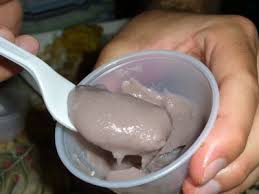
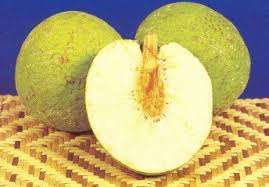
Dr. Shintani decided to put a group of 20 obese native Hawaiians on a strict diet. Actually, he let them eat as much as they wanted. The only catch was that the food they ate was from the pre-contact (pre-Captain Cook) Hawaiian diet. On the menu each day was poi, poi and more poi. There were also sweet potatoes, breadfruit, greens, seaweed, fish and chicken.

The results: the average weight loss for the group was 17.1 pounds in 21 days. On top of that, they all experienced a lowering of their blood pressure, cholesterol and blood glucose.

My hula sisters gave this diet some serious thought. One confessed that she really loved poi and would find that part of the diet no hardship. As for the breadfruit, those who had tried it said that it was quite bland. But someone piped up and said, "It's not bad with butter!" Then she realized that butter would not be on the diet. "Yeah, the early Hawaiians couldn't milk the chickens," I noted.

But those diet results were quite impressive. Just the thought of dropping that many pounds in that short amount of time has me suddenly hungry for poi. For now, I'll settle for popcorn.

Thursday, September 10, 2009

Baibala Hemolele

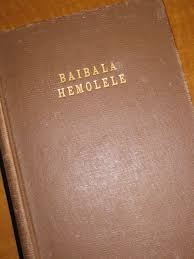
I got all religious on my hula sisters tonight. For my Fun Fact I preached about the Holy Bible, or, as it's called in Hawaiian, Ka Baibala Hemolele.

I stumbled across an interesting item recently about the Hawaiian Bible Project and the work to create a new Hawaiian translation of the Bible.

But I already knew that the Bible was the first book to be published in the Hawaiian language and that many Hawaiians learned to read their own language by studying the Bible.

In fact, before the Congregationalist missionaries from New England came to Hawaii in 1820, the Hawaiian language was strictly oral. Rather than having written histories and stories, the people transmitted information through chants that were memorized by generation after generation.

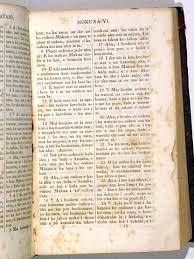
The missionaries set up a printing press at the Mission Houses, which still exist, now as a museum, in Honolulu. Almost immediately after their arrival in 1820 the missionaries began transcribing the spoken language and publishing religious tracts in Hawaiian. But their main goal was to put the Bible in the hands of the native people. To that end, they formed a committee of missionaries and Hawaiians who translated the Old Testament from Hebrew and the New Testament from Greek. It took 19 years. The first printing of the Bible was in 1839.

The printing press didn't have characters for the diacritical marks now commonly used in Hawaiian, the 'okina and the kahakô. Subsequent editions, in 1868 and 1994, also did not have them. The American Bible Society, which had overseen those later editions, decided to stop printing the Baibala Hemolele after 1994 because at that time they deemed Hawaiian a dying language.

Of course, the situation changed rather rapidly after that, with widespread immersion schools creating a new generation of Hawaiian speakers. By 2002 the Hawaiian Bible Project was at work, not only creating a new translation complete with diacritical marks, but preparing to publish the new translation in digital form, complete with audio tracks. By the end of 2009 the full translation should be available at www.baibala.org. The previous editions of the Hawaiian Bible are already online at that site.

When I visited the Mission Houses in Honolulu last February, I saw the printing press, but I was told that it was not the original press. The original press had been replaced after about 20 years. A couple of months later I was researching an article about Forest Grove, Oregon, and I visited the museum in Old College Hall, built in 1851, at Pacific University. Pacific was founded by Congregationalist missionaries, the same denomination as those who went to spread Christianity in Hawaii.

A docent took me through the small museum, pointing out all sorts of odd artifacts that related to the history of the university. But in a dusty corner, there was an old printing press. That, he said, had originally been in Honolulu. But when the missionaries there got a new printing press, they sent the old one to what was then Tualatin Academy in Forest Grove.

It's rather amazing to realize that the printing press that completely altered the Hawaiian way of life by publishing a Hawaiian language Bible now sits in a little museum thousands of miles away in Oregon. The university, incidentally, has a large number of Hawaiian students. (See my post on their wonderful lû'au.) They might be surprised to learn that this forgotten treasure now sits under a layer of dust in their college museum.

Friday, September 4, 2009

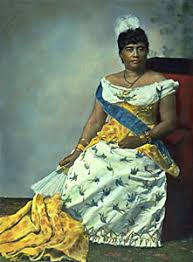
Happy Birthday, Your Majesty!


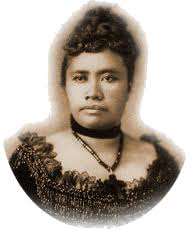
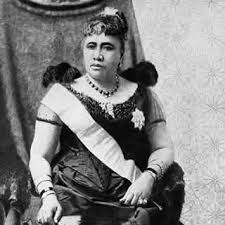
In yesterday's hula class I shared the Fun Fact that the day before, September 2, would have been the 171st birthday of Hawaii's last reigning monarch, Queen Lili'uokalani. Ever gracious, my hula sisters remarked that she didn't look a day over 170.

Born Lydia Lili'u Loloku Walania Wewehi Kamaka'eha, she will not be soon forgotten in Hawai'i. Her slogan, Onipa'a ("Be Steadfast"), is remembered by the people engaged in the struggle for sovereignty, or those who are just plain unhappy at the disgraceful way her short reign ended.

She came to the throne after her brother, David Kalâkaua, died of illness in San Francisco during a state visit. She set out to undo some of the concessions he had made to the powerful American businessmen, who had sought legislation that would be favorable to their enterprises, such as sugar and pineapple. Kalâkaua had given in and signed the so-called Bayonet Constitution in 1887. It got its name because the king was, at least figuratively, at the point of a bayonet when he signed.

The businessmen, alarmed by the queen's intentions, quickly formed what they called the Committee of Safety, which was supposed to ensure the safety of Americans, who would be losing the vote if all went the queen's way. In 1893, after she'd been queen for a bit under two years, Lili'uokalani was overthrown by the Committee, with the armed support of 162 American sailors and Marines.

Grover Cleveland, who was president at the time, at first decried the overthrow and stated that it was patently illegal. He offered to restore the queen to her throne -- with one catch: that she absolve the Committee of any wrong doing. The Queen gave the wrong answer. She said she intended to execute them.

Sanford Dole, of Dole Pineapple fame, was declared president of the new Republic of Hawaii on the Fourth of July, 1894. The former queen was arrested Jan. 16, 1895, along with many of her supporters. She was held prisoner in an upstairs bedroom of the 'Iolani Palace.

Visiting that room is a heartbreaking experience. Her captors even covered the windows so she couldn't see the palm trees, the sky or the sea, or her own people. She was allowed one maid, who helped her make a quilt depicting events in her life that is on display in that room today. She also composed beautiful songs while she was held prisoner for eight months.

To save her followers from death sentences, the same sentences she had expected to mete out to those who overthrew her, she abdicated her claim to the throne.

She died at age 79 in 1917 in Washington Place, the Honolulu home where she had lived with her husband before becoming queen. Think of her the next time you hear her most famous song, Aloha Oe, and these haunting words: "One fond embrace before I now depart. Until we meet again."