Sunday, February 8, 2009

I'm a bit late getting on board, but I'm doing my part to give the Oregon Food Bank a hand during these hard times. They've enlisted bloggers to encourage their readers to make donations to this worthy organization.

The shelves are too bare these days, especially considering the escalating need for support for hungry families.

This promotion will run through February. It's easy to help. Just click on the logo and you'll be directed to Oregon Food Bank's donation page. And if you don't mind, in the Tribute section, In Honor Of: could you please write "Blog for Food"? Just to keep track. Thanks.

I just looked at the logo closely and now I see that's a huge fountain pen. I thought it was a rocket. Thought that was an oddly warlike logo for a food bank. But now I get it. We bloggers, we wordsmiths, are pitching in to help. Won't you?

Mahalo.

The Hämäkua Coast

My Fun Fact at last Thursday's hula class took the form of a geography lesson. A dance we learned recently accompanies the mele ma'i entitled "Ka Ua I Hämäkua," or The Rain at Hämäkua." The first line is about the rain at Hämäkua and the sea at Opae'ula. So I was curious myself and figured my hula sisters as well would like to know where these places are.

What we did know was that the place names figured in the life of Kamehameha the Great. I figured they would be in the same vicinity, but as it turns out, Hämäkua and Opae'ula are hundreds of miles apart on the Big Island of Hawai'i.

Hämäkua is the name given to the north coastline that runs west from Hilo to North Kohala, which is thought to be the king's birthplace. The coast is characterized by lush vegetation, thanks to the rain mentioned in the song's title. The rainfall along the Hämäkua Coast, in fact, averages 84 inches, but in some places is as high as 140 inches a year. There are pali, or high cliffs and many waterfalls. Akaka Falls, which is 400 feet high, is the best known of these.

As I told in an earlier Fun Fact, one of the several parallels between the life of Kamehameha and the life of Jesus was that the ruler in Hawai'i at the time of Kamehameha's birth somehow knew of the baby's great destiny and ordered baby boys in the region to be slaughtered. Kamehameha was taken into hiding into the Waipio Valley along the coastline.

The ancient forests were once cleared to grow sugar cane, but the last sugar cane plantation shut down in 1994. Now the land is cultivated by small farmers growing traditional crops, such as taro.

The other place name, Opae'ula, is on the west coast of Hawai'i, just south of Kona. Kona was the seat of Kamehameha's power once he became a king. Opae'ula is actually a 12-acre pond that was an ancient fish pond. The word opae'ula means red shrimp. There are still plenty of the little buggers living in the water there. Now Opae'ula is a bird sanctuary. The birds find the little shrimp quite tasty. I found several YouTube videos showing the shrimp swimming in tanks. There's even a web site about them that's called petshrimp.com. Who knows? Maybe Hawaiian red shrimp are catching on and someday will be a greater sensation than sea monkeys.

Sunday, February 1, 2009

One Hänau; One Hänai

Last Thursday night I returned to my habitual weekly activity of presenting a Fun Fact about Hawaii to my hula class. I based the latest Fun Fact on a writing project I'm currently involved in, as well as on a lesson from my distance learning Hawaiian language class through Kamehameha Schools.

My writing project is to write the script for a documentary film being made by an old friend, Lois Leonard. Lois and I met at Camp Wind Mountain as Girl Scouts, then we became classmates at Grant High School in Portland. Lois's past jobs at the Oregon Historical Society and at Fort Vancouver have turned her into quite the Oregon history enthusiast. She chose David Douglas as the subject of her latest documentary film. Most Oregonians know Douglas as the man for whom the Douglas fir was named.

There is a Hawaii connection because Douglas, born in Scone, Scotland, in 1799, traveled to Hawaii after several years of botanical field work in the Pacific Northwest. He died on the Big Island July 12, 1834. According to the man who found his body, he fell in a wild cattle trap and was mangled by a trapped bull. But the large amount of money Douglas had with him was gone and, shortly thereafter, so was the guy who "found" the body.

A memorial was erected in 1934 in Douglas's memory by the Burns Club of Hilo to honor a fellow Scot. A grove of Douglas firs was planted there, at a spot now known as Käluakauka (the doctor's pit). It's pictured above. I will be visiting that place next week with Lois and the film crew.

Now here's where my Hawaiian class comes in. A recent lesson was about the expression one hänau, which means the sands of birth. It's the Hawaiian way of saying birthplace. One's adopted home is called one hänai, adopted sands.

Our homework was to write about our own one hänau or one hänai. So I wrote about my love for Douglas firs as a native of Oregon, my one hänau. But I said that when I am in Hawaii standing in the shade of probably the only Douglas fir grove in the islands, I will feel like it's my one hänai.

Wednesday, January 28, 2009

PUA

There was no Fun Fact for my hula class last week; another food-related event tore me away. I was off at a Dungeness crab dinner put on by the Portland Culinary Alliance, of which I am president. I do love my hula class, but I would never pass up an opportunity to eat one of my favorite foods, the sweet delectable meat from a local specialty here in Oregon, the Dungeness crab. Yum.

But the following weekend I did attend a practice session that a handful of hula sisters participate in every Saturday. And there, at the Aloha Bally's, we saw our kumu hula, Lisa Chang, who was just finishing up her morning aerobics class. I apologized to her for missing two hula classes in a row. She just smiled and said, "Bring your 'ukulele to the next class." Oh oh.

Our hula class is apparently going multi-media by incorporating live music, as played by hula sisters who have been studying 'ukulele. There are three of us now in the "advanced" class. Our kumu, Lisa, started out with our class but had to drop out because of the many demands of running the halau. Now she's starting all over again with the beginners' class.

The main song we're supposed to practice in order to play with the class is the classic tune "Hawai'i Aloha," written in the mid-1800s by a missionary to Hawaii, Lorenzo Lyons, who became fluent in Hawaiian and was known to his flock as Makua Laiana (Father Lyons). "Hawai'i Aloha" is sung at public gatherings before everyone disperses. Lisa apparently intends to give our occasional public performances more of a Hawaiian flavor by adding this special farewell as our concluding performance.

It's a good thing, then, that I have been practicing. And now, in addition to my Sunday afternoon 'ukulele class, I've been going to the monthly gatherings of the Portland Ukulele Association, or PUA for short. Pua, by the way, is the Hawaiian word for flower.

PUA is a convivial and talented group. I've got a long way to go before I dare perform during their open mike events, but it's good for my confidence to see that I can at least play along and know how to play most of the chords.

I discovered PUA last June when I bought a ticket for one of their two concerts that concluded several days of workshops at Reed College led by top musicians from all over the country. I had no idea it would be such a fabulous concert, but all the people lined up in front of Vollum Hall begging for tickets to the sold-out show should have given me a clue.

The show started at 7:30 and lasted till almost 11 p.m., though I never looked at my watch until it was over. I was totally captivated, enthralled and delighted by the marvelous 'ukulele players, solo and in groups, who entertained the crowd after teaching workshops all week. It was one of the best shows I've ever seen. I've heard since then that PUA's ukulele festival is considered the very best in the country -- and believe me, there are a lot of ukulele festivals out there!

PUA's annual concerts will be held Friday, June 19, and Saturday, June 20, this year. I'll try to make it to both of them and will be in line for tickets as soon as they're available. Wouldn't miss this for anything . . . maybe even Dungeness crab!

Friday, January 16, 2009

Hawaiian Food

Last night I missed my hula class because I was a guest speaker at Diane Morgan's food writing class. I offered tips of the trade to 17 aspiring food writers. Although food writing is just one area of my varied career, I was able to give them a glimpse into the life of a newspaper and magazine writer, dealings with editors, hassles over contracts, pay, etc. I told them I'm not a recipe writer, but I approach the topic of food as a journalist, looking for business, travel or cultural angles.

Because of my fascination with all things Hawaiian, I have naturally taken a great interest in the food. Which is not to say I'm a huge fan of it. As cuisines go, Turkish food is still at the top of my list.

What I remember most about the food from my first visit to Hawaii is the fruit -- all sorts of tropical varieties I'd never tasted before -- and the coconut syrup I poured over pancakes. I never attended a luau, so my introduction to traditional Hawaiian fare didn't come until after I'd joined my hula halau. Occasional potlucks or catered Hawaiian meals are part of the group activities. A class potluck gave me my first taste of foods that are near and dear to the hearts of my classmates who were raised in the islands.

My first impression of the groaning tables heavily laden with Hawaiian foods of all sorts was that it sure was brown and there sure was a lot of meat. Somehow I expected more colorful fare, more produce and more seafood. And once I tasted it, I was somewhat overwhelmed by how bland some dishes were and how extremely salty others were. By now, I've developed more of a taste for Hawaiian food, but I would never choose it over French, Italian or (my favorite) Middle Eastern food.

Here's a brief summary of the traditional dishes that I have encountered at Hawaiian parties.

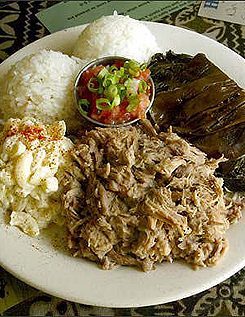
Kalua Pig -- When I was told the name of this shredded pork dish I assumed the word was Kahlua and that I was about to sink my teeth into meat flavored with the sweet coffee liqueur. Not a chance. Kalua refers to the method of cooking the pig in an underground oven, called an imu. The flavor is smoky and salty. Kalua pig is pictured above.

Chicken Long Rice -- Fooled again. I kept looking for the rice. Turns out, that's what they call Chinese cellophane noodles, which are cut into manageable (but still long) lengths, softened and served with cooked chicken that's been marinated in soy sauce, sesame oil, minced ginger and garlic.

Huli Huli Chicken -- Huli huli means to turn, and this chicken is turned on the grill and basted frequently with a sauce made of ketchup, soy sauce, brown sugar, sherry, garlic and ginger.

Lau Lau -- Fish, beef, chicken or pork wrapped in ti (taro) leaves and steamed. It's pictured above at the top right.

Lomi Lomi Salmon -- Salted fillet of salmon is shredded with the fingers and mixed with chopped Maui (sweet) onion and tomato. Lomi lomi means massage, and you're supposed to massage the ingredients together with your fingers. It's pictured above in the little cup.

Poke -- This is one of my favorites. It's like a Hawaiian ceviche. Raw ahi tuna is diced and mixed with minced onion, soy sauce, sesame oil, pepper and Hawaiian salt. It's pronounced PO-kay.

Macaroni Salad -- This simple salad is ubiquitous. It really surprised me to see how popular it is. A heaping mound of it accompanies just about any dish, along with a scoop or two of white rice. (Gotta get those starches!) Both are pictured above on the left. In the Hawaiian version, the macaroni is cooked way past al dente until the pasta is very plump and soft. Then it's mixed with loads of mayo and seasoned with salt and pepper. There are variations, with other ingredients added, but it's usually plain.

Spam Musubi -- This was another shock to my senses. There's a huge Japanese influence on Hawaiian cuisine, so I'd come to expect seeing sushi on the potluck table. But sushi with Spam? At first I thought it was a joke -- I've been to Spam parties before where everyone's supposed to come up with a creative and possibly comical way to use the stuff. But this appetizer has become common fare. It's sticky rice in the shape of a Spam can, with a slab of Spam at one end, wrapped in nori (seaweed).

Haupia -- This coconut pudding is the most common dessert I've seen. It's made with coconut milk, whole milk, sugar, cornstarch and vanilla, cooked till thickened, chilled till firm, then cut in squares. Another one of those bland foods I've acquired a bit of a taste for. But I wouldn't walk a mile for it.

Poi -- Last but not least. It's a Hawaiian staple, made from pounding the taro root. Of course, I'd heard of poi, but I was surprised just the same, first by its color (light purple) and then by its taste (not bad). Not good either. Again, I wouldn't go out of my way to try it.

Has this description of Hawaiian food made you hungry?
Me neither.

But if you'd like to try preparing any of these dishes, here's a handy web site. Better yet, visit a Hawaiian restaurant. In Portland, my favorite is Ohana Hawaiian Cafe, at Northeast 63rd and Sandy Boulevard.

Friday, January 9, 2009

Lonely Guy the Great

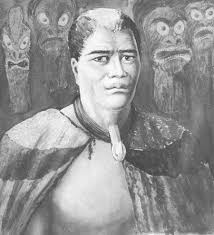
The Fun Fact I delivered to my hula class last night was about Kamehameha the Great, who united the Hawaiian Islands in the late 18th century and early 19th century. He was the first in a line of monarchs who reigned over the islands until 1893, when Queen Lili'uokalani was overthrown.

There was a lot about this king's story that really amazed me. First of all, his name. He had a reputation as a fierce warrior who spilled rivers of blood in his quest to rule the entire island group. So you would think his name would denote all sorts of righteous qualities, such as bravery, leadership or even skill on a surfboard (the sport of kings -- Hawaiian kings, that is).

No. Kamehameha translates as Lonely Guy. So this fearsome monarch was Lonely Guy the Great!

Of course, as soon as I shared that Fun Fact, one of my hula sisters broke into song: "Hey there Lonely Guy," sung to the tune of that 1970 hit, "Hey There Lonely Girl."

There were more amazing things to come. Turns out, Kamehameha's life story shares events that also occurred in the lives of Jesus, King Arthur and Mark Twain!

According to legend, a comet was supposed to light up the night sky when the future unifier of the islands was born. Sure enough, when little Lonely Guy was born in 1758, Halley's Comet soared over the island of Hawai'i. (Mark Twain was born under similar circumstances 77 years later when Halley's Comet returned.)

I'm guessing his was the only birth among the ali'i (royalty) that night, so the people figured he was the long-awaited unifier. The king who ruled Hawai'i Island at the time wasn't exactly charmed by this story of the little baby who would grow up to be a great ruler, so he ordered that the baby be killed. Sound familiar yet? Baby Kamehameha was taken into hiding for about the first five years of his life.

Here's where the King Arthur part comes in. As you may recall, King Arthur proved his exalted destiny by pulling the sword Excalibur from a stone. Kamehameha banished any doubt about his destiny by hoisting the 5,000-pound Naha stone. The immense chunk of lava had sat undisturbed for eons. Only the person who would one day unite the island would ever be able to move it. Kamehameha was said to have performed this amazing feat when he was only 14.

By 1795 he had gained control over all the islands but Kaua'i and Ni'ihau. This he had accomplished through bloody warfare. But by 1810 he had apparently mellowed enough to try his hand at diplomacy. The last two islands decided then not to fight him but to join him.

Having accomplished his destiny, Kamehameha retired from the royal court in Honolulu to his home island of Hawai'i in 1812. He died in 1819 and was succeeded by his son, Liholiho, who took his father's name, becoming Kamehameha II, or Lonely Guy No. 2.

Tuesday, January 6, 2009

A New Year, A New Class


Our abundant December snowfall, coupled with the holiday season, kept our hula class from meeting for several weeks. We'll gather again on January 8. Hugs all around, I'm sure.

Once the snow melted on the last weekend of December, our 'ukulele class was reunited, also with hugs all around. After being confined to our homes by huge snowdrifts, it was fantastic to see some fellow humans (other than the ones we live with). We met again last Sunday and even had a little spiked eggnog to go with the strumming.

This week another class began for me, the continuation of the Hawaiian language class I'm taking as distance learning adult education from Kamehameha Schools in Honolulu. This is my second course; my first was in November. There was actually an introductory class before that, which I missed. But from the Hawaiian I learned in two one-week intensive classes from a teacher visiting from Honolulu, Tuti Kanahele, I was able to keep up.

I really enjoy the online language class and all the multimedia aspects of it. There are lots of background articles, photos, videos, songs, as well as interactive quizzes and games to make learning Hawaiian even more fun. On top of all that, Kamehameha Schools rewards people for finishing their classes with lovely gifts! From my efforts in November I received a green A'o Makua (adult education) T-shirt, which I wear to the gym; a children's book about the life of Bernice Pauahi Bishop, the Hawaiian princess who was the founder of Kamehameha Schools; and my favorite gift, a Hawaiian Word-A-Day calendar. Today being Iänuali 6 (January 6), the word of the day is 'alani, which means orange (the fruit and the color).

Can't wait to see what my reward for finishing this month's class will be!