Showing posts with label hula. Show all posts

Saturday, April 11, 2009

Hula Costuming

It's that time of the year again when our halau starts planning for summer hula performances and ordering all the necessary fabric, dresses and accouterments for our costumes.

We need two costumes, one for the 'auana, or modern hula, and one for the kahiko, literally ancient, but meaning the more traditional hula. The basic difference between the two styles is that 'auana hula is more carefree, with lots of smiles and "modern" instruments, namely ukuleles and guitars.

The costume is usually a long, figure-fitting dress in a pretty Hawaiian print. We usually order our dresses from CC Fashions in Honolulu. I stopped by there when I was in Honolulu in February and it was clear they cater to the Japanese hula dancers, with all signs in Kanji and sales people fluent in Japanese.

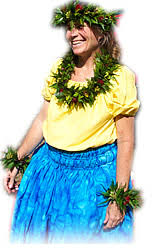
For our kahiko dance, accompanied only by the ipu gourd drum and chanting, we will probably sew our own costume, basically a skirt and top in cotton/poly fabric, with lots of elastic here and there. But what really completes the kahiko costume is the küpe'e, or adornment.

We wear leafy bands on our wrists, ankles and head, sometimes neck, as well. In Hawai'i, there are really gung-ho halaus that seek their küpe'e in the forest and string the leaves together. We order silk leaves already strung together with elastic.

For my Fun Fact at our last class, I shared some information about how hula dancers costumed in days of yore. Don't tell my beloved dog Daphne this, but in the old days küpe'e often were constructed from dog teeth. The choppers were pierced and then strung together, sometimes on fiber netting to make six or so rows of clinking, clanking teeth. This garment was tied on the calf right under the knee. It was an adornment as well as musical instrument, for the noise of the chattering teeth contributed to the performance.

The purpose of the küpe'e was to draw attention to the movements of the hands and feet. After all, that's where the hula story is told.

Back then, the skirt, called a pä'ü, was not poly/cotton, but was made of kapa, which was pounded bark. The resulting fabric was decorated with stamped and painted patterns.

The men wore a malo, a loincloth made of kapa. And they and the women dancers went topless. Ah, the good old days!

Saturday, November 15, 2008

King Kaläkaua


This is the Fun Fact I shared with my hula class this week.

One of the steps we do in hula is called the kaläkaua, which was the name of Hawai'i's last king, David Kaläkaua. He reigned from 1874 until his death from hard living in 1891. He loved to party. Robert Louis Stevenson, who became Kaläkaua's close friend during his Hawaiian sojourn, wrote how the king thought just about every occasion was worth celebrating with bottles and bottles of Champagne or gin. He often stayed up all night drinking and gambling at the Royal Boat House in Honolulu Harbor, not far from the palace he had built, 'Iolani Palace. So when he died at age 55, cause of death was not surprisingly cirrhosis of the liver and kidney failure.

Although he is known as the Merrie Monarch for his love of a good party, he's remembered more for his talent as a composer and one who encouraged interest in the musical traditions of Hawai'i. Until he came to the throne, traditional music and dance had gone underground, because of the missionaries' disapproval of "lascivious" movement and lyrics. But nine years after becoming king, Kaläkaua decided a coronation party was in order, and he used the occasion to reintroduce the hula to public life. He also started the tradition of what is known as hula 'auana, or modern hula, which was accompanied by the relatively new instruments, guitar and 'ukulele. When he turned 50, Kaläkaua threw another huge party, which he called his Jubilee. It lasted for two weeks, with many dancing groups coming forth to dance the hulas that had long been forbidden.

Kaläkaua is remembered for bringing about the first Hawaiian cultural renaissance, the second one having begun in the 1970s and 80s. The dance step, kaläkaua, was used in the opening of a hula that was performed in his honor at his coronation party. Every year, in Hilo, the grand hula festival known as Merrie Monarch is held to honor the memory of King David Kaläkaua.

Tuesday, November 11, 2008

Aloha, Oregon, that is . . .


I've been a student of hula for almost two years at the Bally's gym in Aloha, Oregon, a suburb of Portland. I am not Hawaiian, rather, I am pretty much German, except for a wee bit of Scottish and Irish. I trace my initial interest in hula back to my honeymoon, when he and I visited the Polynesian Cultural Center on O'ahu. I do remember being quite taken with the Tahitian dancing -- hips revving from zero to 60 on the very first drum beat -- more than the relatively sedate hula.

But when I first observed the hula class in Aloha, I remember thinking that the dancing was more athletic than I'd remembered from watching the sedately swaying ladies in Hawai'i. Now that I'm a member of the class, I can attest to that fact. It's a workout. I refer to our weekly class as Hula Boot Camp.

Last year I took a week-long Hawaiian language class when a teacher came from O'ahu to teach members of our halau (hula group). About a year ago I joined a 'ukulele class that began at our halau. I'm still hula'ing, playing the 'uke, and speaking Hawaiian as best I can. Lately I've been sharing with my class some of the fascinating things I've learned about Hawaiian culture.